
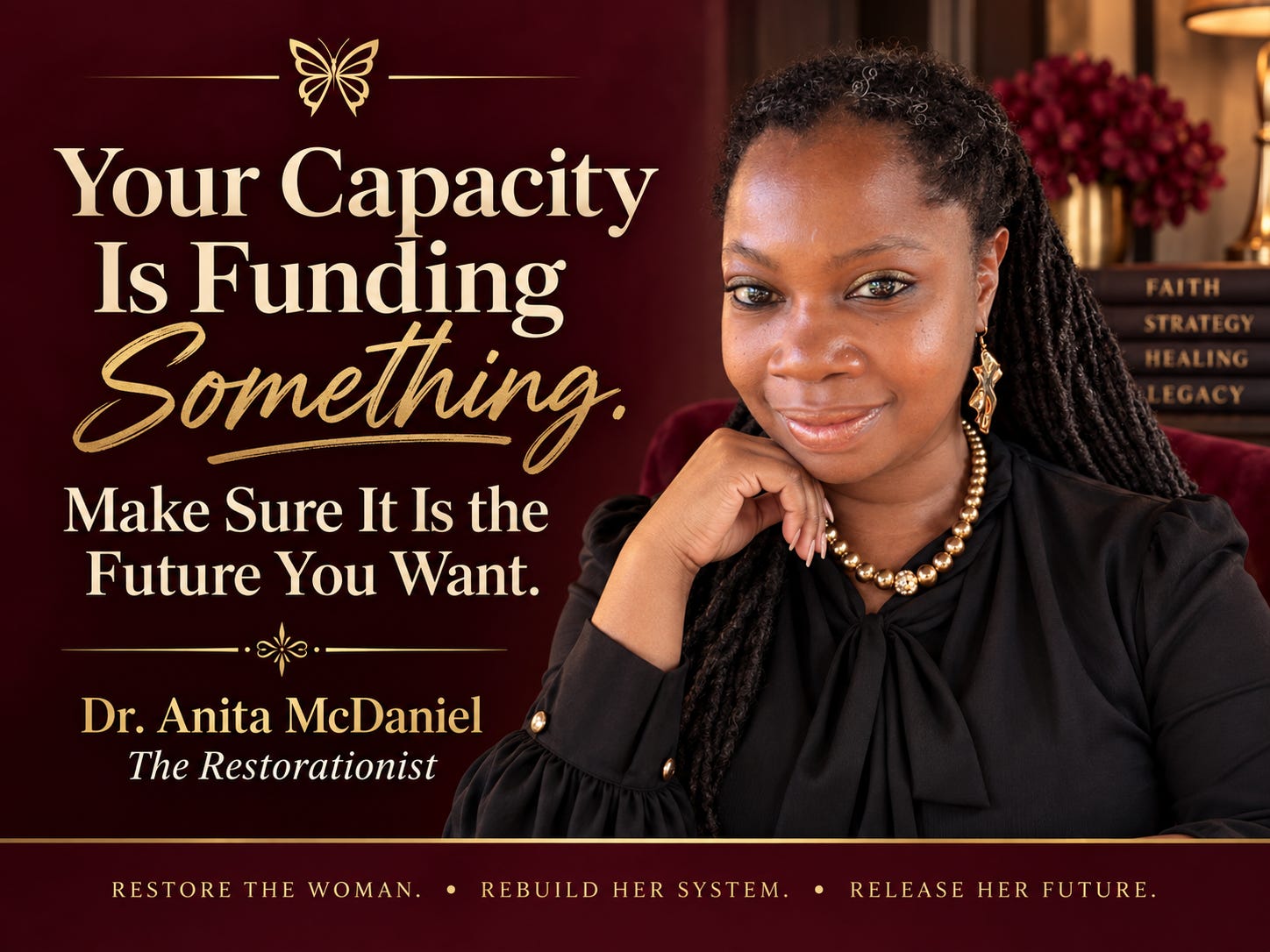
I have been thinking about where our capacity goes.
Not just our time.
Our capacity.
Because you can have two free hours and still not have two hours of capacity.
You can have an open Saturday and no mental room to create.
You can have a night without meetings and still be carrying six conversations in your head.
You can technically have time for yourself and still have nothing left of yourself to give.
So I think we need a better conversation than time management.
We need to talk about allocation.
Because your capacity is funding something.
Every yes funds something.
Every responsibility funds something.
Every relationship receives something.
Every problem you solve requires something.
Every decision you make spends something.
Every person who has access to you is receiving some portion of a resource that is not unlimited.
And here is the part I want us to pay attention to:
Your future needs some of that resource too.
The life you say you want is not built only with money.
It needs your attention.
Your imagination.
Your emotional presence.
Your creativity.
Your ability to make decisions.
Your willingness to try.
Your physical energy.
Your courage.
Your capacity.
And if all of that is already committed to maintaining the life you currently have, what exactly is left to build what comes next?
That question has been sitting with me.
Because women are constantly told to dream bigger.
Set the goal.
Write the vision.
Start the business.
Take the trip.
Improve the marriage.
Go back to school.
Build the ministry.
Create the next thing.
And I believe in vision.
You know I do.
But a vision without capacity eventually becomes another demand.
Another thing sitting on a list reminding you of what you have not done yet.
Another reason to feel behind.
I do not want that for women.
I want us to get more strategic.
Before we ask:
“What do I want to build?”
We also need to ask:
“What will building it require from me?”
And then:
“Where is that capacity currently going?”
Now we are having a different conversation.
Maybe you keep saying you want to write the book.
But the mental energy you would use to write it is currently being spent remembering everybody else’s life.
Maybe you want deeper intimacy in your marriage.
But by the time you have given emotional energy to work, family, friends, ministry, problems, texts, requests, and everybody else’s feelings, there is nothing left but logistics.
Maybe you want to build a company that does not depend entirely on you.
But you keep spending your leadership capacity doing tasks somebody else could be trained to do.
Maybe you want more joy.
But every open space gets immediately filled with something productive.
Maybe you want to hear God more clearly.
But silence makes you uncomfortable because your system has gotten used to constant input.
The issue may not be whether you want those things.
The issue may be whether anything in your current life is actually funding them.
That is what allocation means.
You cannot say something matters and continuously give it whatever is left.
At some point, what matters has to receive resources on purpose.
We understand this in business.
If a company says innovation matters but puts no money, people, time, or attention behind innovation, innovation is not actually a priority.
It is a sentence in a strategic plan.
The same thing can happen in our lives.
“I want more rest.”
But rest gets leftovers.
“I want to take care of my body.”
But my body gets whatever energy remains after everybody else has been served.
“I want to build.”
But building gets the scraps after maintaining.
“I want deeper relationships.”
But presence gets whatever is left after productivity.
“I want more of God.”
But prayer gets the minutes that survive the schedule.
Eventually we have to ask:
What does the allocation say I actually prioritize?
Not what I say.
What does the system say?
Because systems tell the truth.
Your calendar tells the truth.
Your attention tells the truth.
Your spending tells the truth.
Your energy tells the truth.
Your automatic yes tells the truth.
And sometimes that truth is uncomfortable.
Not because you have done something terrible.
Because you may realize you have been funding an old life while asking God for a new one.
Whew.
Sit with that.
You are praying for expansion while all your capacity is committed to maintenance.
You want freedom while your systems are funded by overresponsibility.
You want creativity while urgency gets first access to your mind.
You want partnership while independence still receives the largest investment.
You want a different future while the present gets everything you have.
That does not mean you abandon your responsibilities.
It means you start governing your capacity differently.
Some things need less of you.
Some things need more.
Some things need delegation.
Some need a boundary.
Some need an ending.
Some need a system.
Some need your full presence again.
And some things that have been living on leftovers need to become funded priorities.
Including you.
That may be the hardest part.
Because women who are accustomed to giving often feel strange intentionally allocating capacity to themselves.
Not because they do not believe they matter.
But because there is always something else that can make a convincing argument for why it needs them first.
There will always be another request.
Another email.
Another problem.
Another person.
Another task.
Another legitimate need.
If you wait until nobody needs anything before you invest in your own life, you may wait forever.
So restoration cannot only be about getting capacity back.
Eventually we have to decide what restored capacity is for.
What are you restoring yourself to live?
What are you rebuilding yourself to carry?
What deserves your best thinking?
What deserves your presence?
What are you preparing to build?
Who are you becoming?
What part of your future needs an investment from you now?
That is stewardship.
And this is where restoration becomes forward-facing.
We are not simply recovering what was lost.
We are restoring resources for what comes next.
So this week, I want you to look at your life like an investor.
Where is your capacity going?
What is receiving the largest investment?
What is getting leftovers?
What are you continuously funding that you no longer want to grow?
And what future do you keep saying you want while giving it almost nothing to work with?
Then ask yourself:
If my current allocation stays exactly the same, what kind of life will it produce?
That answer may tell you what needs to change next.
Because your capacity is funding something.
Make sure it is helping build the future you actually want.
Dr. Anita McDaniel
The Restorationist
Restore the Woman. Rebuild Her System. Release Her Future.