
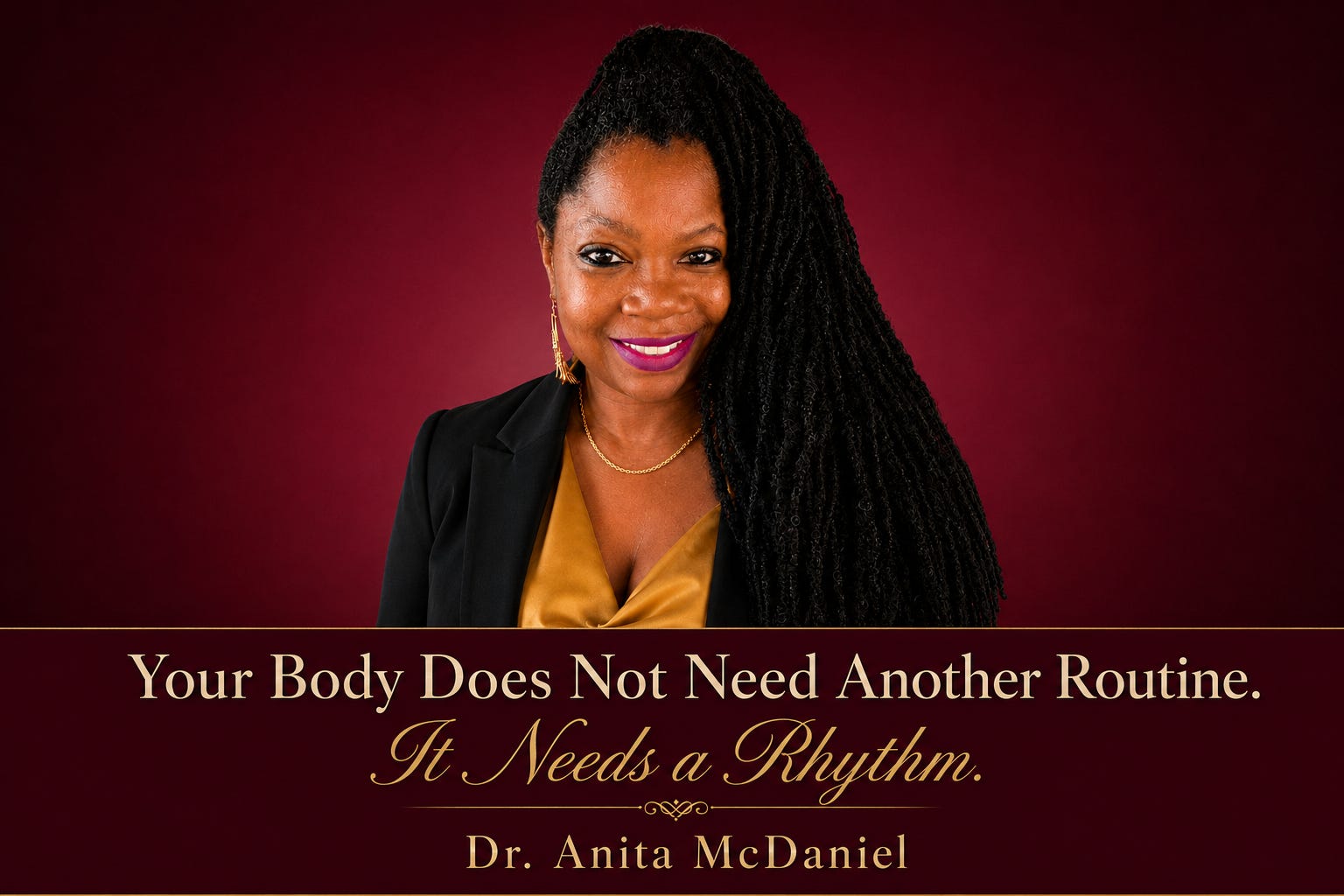
WHOLEHER WELLNESS TRIBUNE Issue 2 | Week of May 18, 2026
Let me guess.
At some point in the last six months you have downloaded a habit tracker, set a 5am alarm you did not keep, started a new morning routine on a Monday, abandoned it by Wednesday, and decided the problem was your discipline.
It was not your discipline.
It was never your discipline.
Here is what nobody in the wellness industry wants to tell you because it is not particularly sellable: your body does not run on routines. It runs on rhythm. And those two things are not the same.
A routine is a schedule you impose on your life. A rhythm is a biological expectation your body already has. One requires willpower to maintain. The other simply requires you to stop fighting your own physiology.
What rhythm actually is
Every cell in your body operates on a roughly twenty-four hour cycle called the circadian rhythm. This is not a wellness concept. It is a biological fact so well established that the scientists who discovered its molecular mechanisms won the Nobel Prize in 2017.
Your circadian rhythm governs when your cortisol rises in the morning, which is a good thing, your body needs that morning surge to wake up and function. It governs when your body temperature peaks, when your metabolism is most efficient, when your melatonin begins to rise in the evening, and when your cells do their most important repair work overnight.
This is where most routines fall apart.
You cannot override this system with enough motivation. You can only work with it or against it. And most of the routines women build in midlife, the late night productivity sessions, the skipped meals, the inconsistent sleep schedules, are working directly against it.
What happens when rhythm breaks down in midlife
Here is the part that matters specifically for you.
In perimenopause and beyond, estrogen begins to fluctuate. What most women do not know is that estrogen plays a significant role in regulating the circadian clock. When estrogen drops, the body’s internal timing system becomes less precise. The cortisol awakening response, that morning surge that is supposed to energize you and set your hormonal tone for the day, becomes erratic. Sleep architecture shifts. Melatonin timing changes.
And then someone tells you to just be more consistent with your morning routine.
I understand the frustration. I really do.
The issue is not your consistency. The issue is that the biological infrastructure your consistency depends on has shifted and nobody told you.
The four rhythms your body is asking for
Sleep rhythm. Your body needs sleep and wake times that are consistent enough to anchor the circadian clock. Not perfect. Consistent. There is a difference.
Eating rhythm. Your body processes food more efficiently at certain times of day. This is not about restriction. It is about timing your meals in a way that supports metabolic function rather than disrupting it. Eating late at night when your metabolism has already begun its overnight protocol is not a moral failure. It is just bad timing.
Movement rhythm. Moderate, consistent movement anchors the circadian rhythm more effectively than intense sporadic exercise. The woman killing herself in the gym three days a month and then resting for two weeks is not building rhythm. She is creating noise.
Stress rhythm. Your body expects cortisol to be high in the morning and low at night. When stress keeps cortisol elevated all day and into the evening, the entire system gets confused. Your body starts storing instead of releasing, inflaming instead of restoring, waking you up at 3am instead of letting you sleep.
That is not a sleep problem. That is a rhythm problem.
What rhythm restoration actually looks like
It is quieter than you think. It is less dramatic than a new program. It does not require a complete life overhaul or a 5am wake-up time or another supplement.
It requires understanding what your specific system needs to return to its natural timing. And that starts with knowing which rhythms are most disrupted in your body right now.
The free assessment at themcdanielinstitute.com is ten minutes. It will show you where your system’s rhythm has broken down and what that is costing you physiologically.
No commitment. Just clarity.
And maybe the relief of knowing it was never about your discipline.
Dr. Anita McDaniel, Ph.D. Doctor of Holistic & Functional Medicine Integrative Restoration Strategist, Brain, Metabolic & Emotional Health