
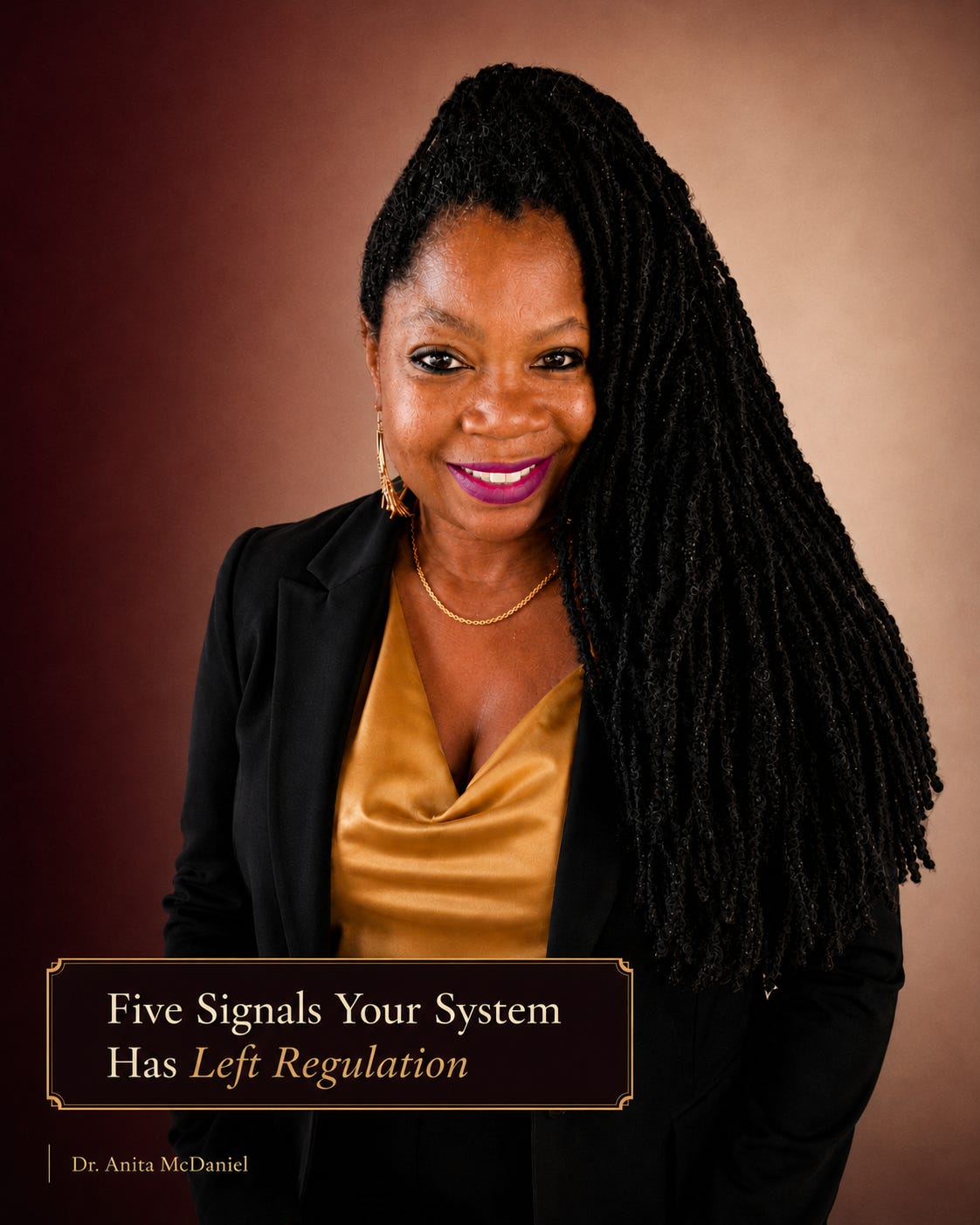
There is a particular kind of tired that sleep does not fix. You know it. Seven hours, eight hours, and the fatigue is still there in the morning, settled into your body like it belongs there.
You have tried doing more. Sleeping earlier. Moving differently. The gap between how you feel and how you want to feel does not close.
Your body is not broken. It is dysregulated. And there is a meaningful difference between those two things.
A broken system needs to be fixed. A dysregulated system needs to be decoded, regulated, and restored. The treatment is different. The timeline is different. The outcome is different. One leaves you managing symptoms indefinitely. The other returns you to yourself.
What I want to walk you through today are the five signals your system sends when it has left regulation. Not the dramatic signals. The quiet ones. The ones you have been explaining away, minimizing, or attributing to stress, age, or your own perceived lack of discipline.
These five signals are the foundation of the WholeHer Restoration Framework. Learning to read them is where restoration begins.
Signal One: The Body Signal
The body is always communicating. Most women in midlife have learned to override that communication in order to function.
The body signal shows up as inflammation that moves around without a clear source, weight trending in a direction that does not respond to what worked before, disrupted sleep that feels hormonal rather than circumstantial, joint stiffness, brain fog that arrives in the afternoon and does not lift, and a persistent sense that your physical system is working against you rather than with you.
What is happening beneath these symptoms involves the HPA axis, the hypothalamic-pituitary-adrenal system that governs your stress response and your hormonal communication. When cortisol has been chronically elevated, and in midlife women it frequently has been, the body begins to prioritize survival functions over restorative ones. Inflammation increases. Metabolic efficiency decreases. The hormonal conversations that once happened smoothly begin to stutter.
This is not aging. This is dysregulation. And it is addressable.
This is where most women stop getting answers.
Signal Two: The Voice Signal
Your voice is not just how you speak. It is the expression of your nervous system’s sense of safety.
The voice signal shows up as a pattern of holding back, editing yourself before you speak, noticing that you have opinions you no longer share. It shows up as the woman who leads meetings but never names what she actually thinks. Who counsels everyone else and cannot remember the last time she was fully honest about what she needed.
From a physiological standpoint, voice suppression is tied to vagal tone. When the nervous system is dysregulated, the ventral vagal state, the state that allows for genuine social engagement and authentic expression, becomes harder to access. The body moves into a protective mode. And the voice is one of the first things it protects by silencing.
When a woman starts to regulate, her voice comes back. Not because she decides to speak more. Because her nervous system finally feels safe enough to let her.
Signal Three: The Identity Signal
Identity misalignment is the most underdiagnosed signal in the framework. It does not show up on a lab panel. It does not have a diagnostic code. But it has a physiological signature that is unmistakable once you know what to look for.
The identity signal shows up as a persistent sense of performing a version of yourself that does not quite fit. As exhaustion that seems tied not to what you are doing but to who you are being required to be in order to do it. As a quiet internal friction between the woman you are becoming and the woman the life around you still expects.
The version of you that is exhausted may be the version you built to survive, not the one you were meant to sustain.
Identity misalignment creates a chronic low-grade stress response in the body. The system works overtime to maintain coherence between the internal and the external, and the energy cost of that maintenance shows up everywhere: in the body signal, in the voice signal, in the emotional and behavioral signals that follow.
That friction has a physiological cost. Most practitioners never measure it.
Signal Four: The Emotional Signal
Emotional dysregulation in midlife women is frequently misattributed to hormones alone. Hormones are part of the picture. They are not the whole one.
The emotional signal shows up as reactivity that feels disproportionate to the trigger, emotional flatness that alternates with overwhelm, grief that does not have a clear source, anxiety that lives in the body before it arrives in the mind, and a reduced capacity to return to baseline after a stressful event.
What is happening physiologically involves the interplay between estrogen, progesterone, cortisol, and the limbic system’s threat detection mechanism. As estrogen fluctuates in perimenopause and beyond, the buffer it once provided to cortisol sensitivity decreases. The nervous system becomes more reactive. Not because something is wrong with you. Because the regulatory infrastructure has been destabilized and has not yet been rebuilt.
Signal Five: The Behavioral Signal
The behavioral signal is the one most women blame themselves for the longest.
It shows up as inconsistency in the habits and practices that used to hold, starting and stopping, knowing what to do and not doing it, making commitments to yourself that you cannot keep even when you genuinely want to. It shows up as the feeling that you lack discipline or follow-through.
This is not a character issue. It is a physiological one. Behavioral consistency requires a regulated nervous system. When the system is dysregulated, the prefrontal cortex, the part of the brain responsible for sustained goal-directed behavior, is working with compromised resources. Willpower is not the variable. Regulation is.
When the system is restored, consistency follows. Not because you try harder. Because the foundation that consistency requires is finally stable.
When All Five Are Active at Once
Most of the women I work with carrying all five signals have been functioning at a high level for years. They have built careers, led families, served communities, and managed complex lives. They are not falling apart. They are not dramatic. They are still producing.
That is what makes this dangerous.
The depletion is invisible from the outside. And high-functioning women are particularly skilled at keeping it that way, from others and from themselves, until the system can no longer sustain the performance.
If you recognized yourself in two or more of these signals, your system is asking for something it has not been given. Not another supplement. Not another habit tracker. A real response to what is actually happening.
The Pathway Forward
The WholeHer Restoration Framework is built on a three-phase methodology: Decode, Regulate, Restore.
Decoding means understanding which signals are most active in your specific system and what they are pointing to physiologically. Regulating means addressing the root condition rather than managing the surface symptoms. Restoring means rebuilding the operating system so that consistency, clarity, and capacity return naturally rather than being forced.
This is not a quick fix. It is a sixteen-week process that changes the foundation, not the surface.
If you want to know which signals are most active in your system right now, the free assessment at themcdanielinstitute.com is where that begins. It takes less than ten minutes. It will name what you have been trying to explain for months.
No commitment. Just clarity.
That is where restoration starts.
Dr. Anita McDaniel, Ph.D. | Doctor of Holistic & Functional Medicine | Integrative Restoration Strategist | Brain, Metabolic & Emotional Health