
WHOLEHER WELLNESS TRIBUNE Issue 3 | Week of May 25, 2026
Let me ask you something.
When did you last feel fully like yourself?
Not the version of you that shows up for everyone else. Not the version that manages, performs, produces, and holds it all together. The actual you. The one underneath all of that.
If you had to think about it for more than three seconds, that is the signal.
The signal nobody is measuring
Every practitioner you have seen in the last five years has probably run labs. Thyroid. Hormones. Vitamins. Inflammation markers. And the results came back normal or close enough and nobody had a real answer for why you still feel the way you feel.
Here is what they were not measuring.
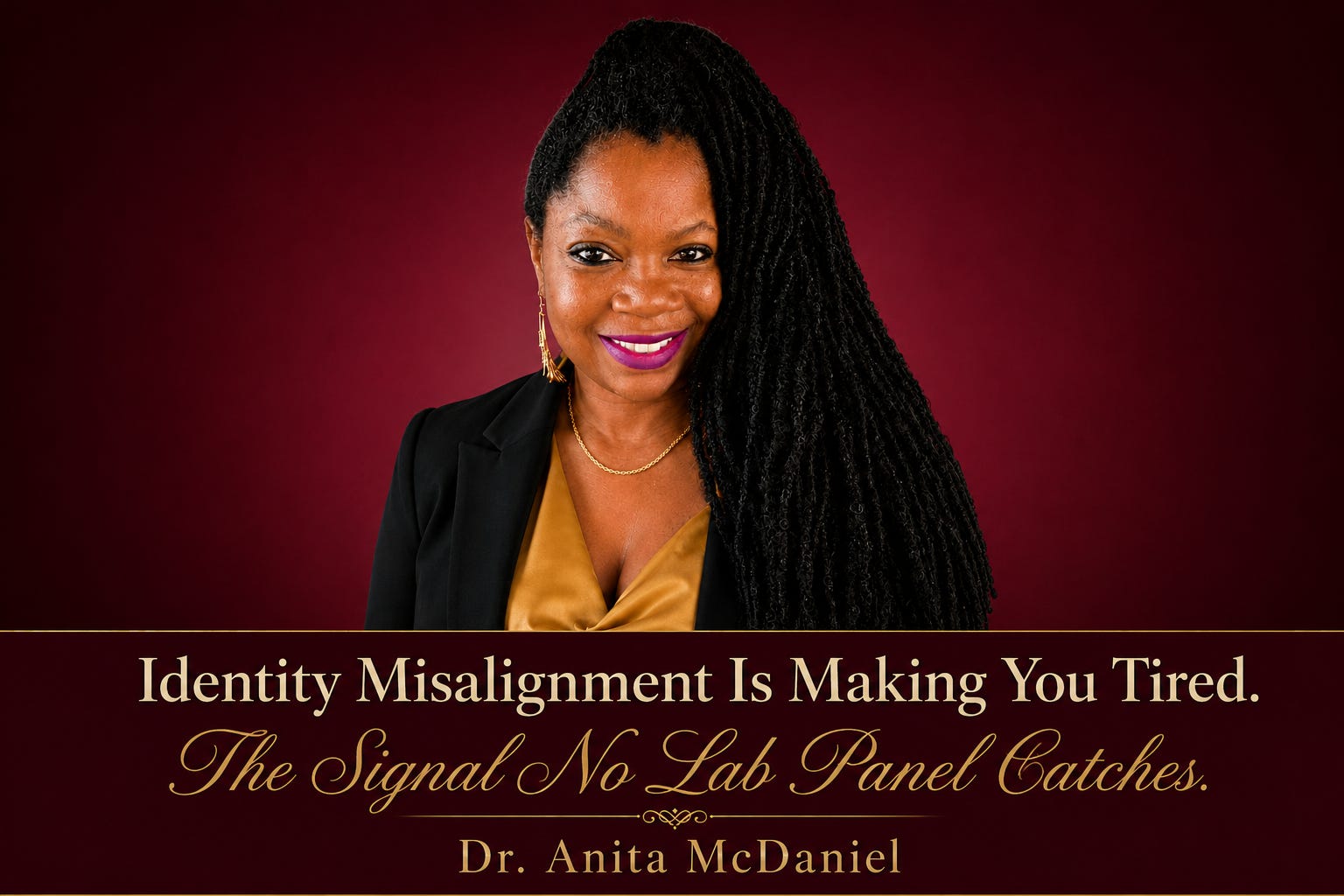
Identity misalignment. The physiological cost of performing a version of yourself that no longer fits. The chronic low-grade stress response your body runs when there is a persistent gap between who you actually are and who your life requires you to be.
It does not show up on a lab panel. But it is one of the most significant sources of depletion in high-functioning women in midlife.
This is where most practitioners stop looking.
What identity misalignment actually feels like
It is not dramatic. That is why it gets missed.
It feels like exhaustion that does not have a clean explanation. Like performing well in your life while feeling strangely absent from it. Like succeeding at things that no longer feel like yours. Like the woman in the mirror is familiar but something about her feels managed rather than real.
It feels like doing everything right and still feeling like something is off.
The version of you that is exhausted may be the version you built to survive, not the one you were meant to sustain.
The physiology behind it
When you are consistently operating outside of alignment with your actual identity, your nervous system reads it as a threat. Not a dramatic threat. A quiet, persistent, low-grade one.
And a nervous system running a quiet threat response all day long does several things you will recognize.
It keeps cortisol elevated. Which disrupts sleep, shifts metabolism, and increases inflammation. It reduces access to the prefrontal cortex, which is why decision-making feels harder and emotional regulation feels thinner than it used to. It suppresses the ventral vagal state, which is why your voice has gotten quieter and authentic expression feels harder to access than it once did.
You are not imagining it. Your body is responding to something real.
That friction has a physiological cost. Most practitioners never measure it.
What alignment actually looks like
It is not a personality overhaul. It is not leaving everything behind. It is not a dramatic pivot.
It is the quiet, consistent experience of your internal reality matching your external expression. Of leading, speaking, deciding, and moving from who you actually are rather than who you have been managing to be.
When a woman starts to come back into alignment, the nervous system begins to settle. Cortisol starts to regulate. The voice comes back. Behavioral consistency returns not because she tries harder but because the system is no longer spending its resources maintaining a gap.
Restoration does not make you someone new. It returns you to who you already are.
The pathway
The identity signal is one of five signals the WholeHer Restoration Framework addresses. Understanding which signals are most active in your system is the beginning of the process.
The free assessment at themcdanielinstitute.com takes ten minutes. It will name what your body has been trying to tell you.
No commitment. Just clarity.
And maybe the relief of being seen accurately for the first time in a while.
Dr. Anita McDaniel, Ph.D. | Doctor of Holistic & Functional Medicine | Functional Integrative Restoration Strategist | Brain, Metabolic & Emotional Health