
Something has shifted in the way I think about strength.
For a long time, strength looked like capacity.
How much can I manage?
How much can I hold together?
How many people can I help?
How quickly can I solve the problem?
How much pressure can I function under without dropping anything?
And if I am being truthful, I became very good at that.
A lot of women do.
We become the ones people trust.
The ones who figure it out.
The ones who remember.
The ones who know what needs to happen next.
The ones people call because they know we will handle it.
There is pride in that.
There is also a cost.
Because eventually people stop asking whether you should have to carry something.
They only notice that you can.
And sometimes we do the same thing to ourselves.
We ask:
“Can I handle it?”
Instead of:
“Should this belong to me?”
Those are very different questions.
I have been thinking about that a lot lately.
Because I am no longer interested in becoming better at carrying everything.
I do not want another strategy for squeezing more into the day.
I do not want another system that allows me to stay available to everybody while pretending I have created balance.
I do not want to become more efficient at disappearing inside responsibility.
That does not feel like growth anymore.
It feels like repetition.
And I think women can become addicted to being needed without realizing it.
Not because we are needy.
Sometimes because being needed has been one of the clearest ways we learned to measure our value.
People depend on me.
Therefore I matter.
Things work because I am here.
Therefore I matter.
Everybody is okay.
Therefore I must be doing something right.
But what happens when your worth is no longer measured by how much breaks without you?
That is a different kind of life.
What if everything does not require your fingerprints?
What if somebody else learns?
What if somebody else remembers?
What if somebody else carries the emotional weight?
What if somebody else solves the problem?
What if you are still valuable when you are not rescuing, fixing, remembering, anticipating, organizing, producing, or holding it all together?
That is where this gets uncomfortable.
Because letting go of responsibility can feel harder than taking it on.
Taking responsibility makes you feel useful.
Releasing responsibility requires trust.
Trust that somebody else can handle it.
Trust that imperfect does not automatically mean wrong.
Trust that everything does not have to happen your way.
Trust that people are allowed to experience the consequences of what they did not prepare for.
Trust that the world will keep turning even if you stop standing underneath it with both hands up.
That last one made me laugh when I wrote it.
Because some of us really do act like gravity is part of our job description.
It is not.
And I am learning that restoration sometimes looks less like adding something beautiful to my life and more like putting something down.
Not because I cannot carry it.
Because I no longer want my life organized around proving that I can.
That matters.
I still want to be dependable.
I still want to lead well.
I still want people to know they can trust me.
But trust should not require self-erasure.
Leadership should not require constant availability.
Love should not require endless emotional labor.
And capability should not become a lifetime sentence.
I think that is part of growing up as a woman too.
There are things you did in one season because you had to.
Then you keep doing them long after the emergency has passed because they became normal.
You became the strong one.
The responsible one.
The flexible one.
The fixer.
The one who does not need much.
The one who will understand.
The one who will make it work.
And then one day you realize:
I actually do not want this role anymore.
Not because I have become selfish.
Because I finally understand that being capable of carrying something does not mean I am called to carry it forever.
I think that is where I am.
I am less interested in proving strength.
More interested in building differently.
Less interested in showing how much I can handle.
More interested in asking what deserves my capacity.
Less interested in rescuing systems that only work because I overfunction inside them.
More interested in creating systems that work because they are actually healthy.
That is a very different measurement of success.
And I like it better.
I want room in my life that does not immediately get filled because somebody discovered I had room.
I want margin that belongs to me before it gets reassigned.
I want energy that is not automatically treated as community property.
I want my presence to be valuable even when I am not producing.
I want to enjoy what I have built instead of constantly maintaining it.
That is not laziness.
That is not withdrawal.
That is restoration becoming mature.
And maybe this is what strength looks like now.
Not:
“I can carry it.”
But:
“I know what is mine to carry.”
That feels different.
And I think different is good.
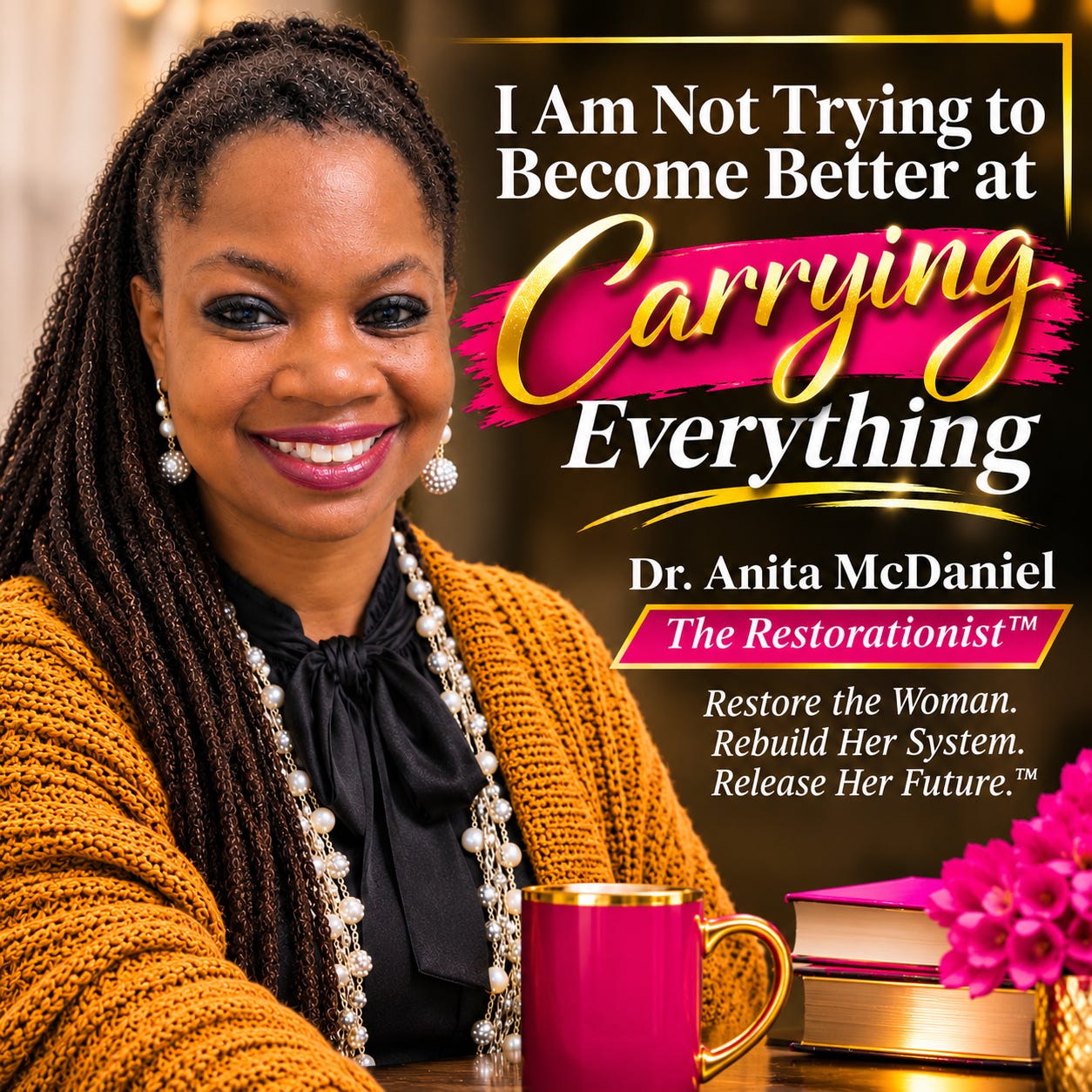
Dr. Anita McDaniel
The Restorationist
Restore the Woman. Rebuild Her System. Release Her Future.