
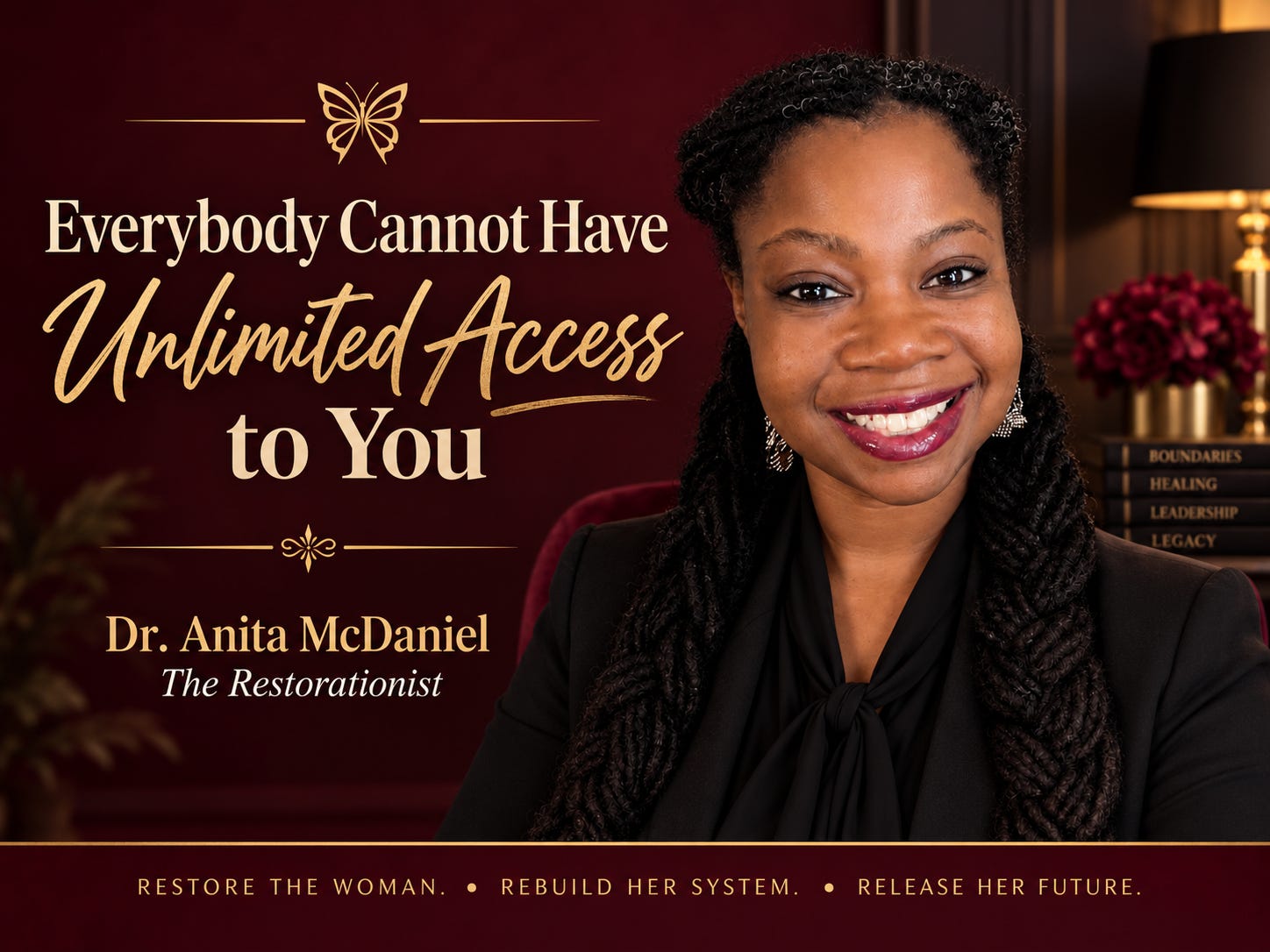
I have been thinking about access.
Not access to your house.
Access to you.
Your time.
Your attention.
Your energy.
Your emotions.
Your availability.
Your ability to solve a problem.
Your willingness to listen.
Your capacity to step in when something is falling apart.
Some women have spent so many years being available that they have never stopped to ask who actually has access to them and why.
The phone rings.
You answer.
Somebody needs something.
You figure it out.
There is a problem.
You step in.
Someone is upset.
You help them process it.
Something was forgotten.
You remember.
Somebody waited too long.
Now their emergency has somehow become your assignment.
And because you are capable, you handle it.
Again.
The issue is not that helping people is wrong.
The issue is when access to you becomes automatic.
When everybody else gets to make withdrawals from a capacity account they are not responsible for replenishing.
That will preach too.
Because capacity is not unlimited.
I know we like to act like it is.
We tell women to manage their time better.
Wake up earlier.
Be more organized.
Create another routine.
Protect their peace.
But you can have the prettiest calendar in the world and still be exhausted if everybody has unrestricted access to what is on it.
At some point, this stops being a time-management conversation.
It becomes an access conversation.
Who gets access to your time?
Who gets access to your emotional energy?
Who gets an immediate response?
Who gets to interrupt what you are doing?
Whose discomfort automatically becomes your responsibility?
Who expects you to fix what they could learn to handle themselves?
And maybe the hardest question:
Who has access to you because you have never required anything different?
That one is uncomfortable.
Because sometimes nobody is violating a boundary.
There was never a boundary there.
You were always available.
Always responsive.
Always willing.
Always the one who could be counted on.
So people built expectations around the version of you that never said, “Not right now.”
And now you are changing.
You want more room.
More presence.
More capacity for your own life.
More time to think.
More space to create.
More energy for the relationships and work that actually matter.
And suddenly you realize something.
You cannot create more room while giving everybody the same level of access they have always had.
Something has to change.
That does not make you selfish.
It makes you responsible for what has been entrusted to you.
Your capacity has an assignment too.
Think about that.
If there is something you believe you are called to build, lead, create, nurture, steward, or become, then the capacity required for that work cannot be available for everything else.
That is not rejection.
That is stewardship.
And this is where boundaries become something bigger than learning how to say no.
A boundary is not simply:
“You cannot do this to me.”
Sometimes a boundary is:
“I know what this capacity is for.”
That changes things.
Because once I know what something is for, I become more careful about where it goes.
We already understand this with money.
If the mortgage money has an assignment, you do not spend it on something random simply because someone asked.
If the payroll money has an assignment, you do not give it away because you felt guilty.
If the money set aside for a major investment has an assignment, every opportunity does not get access to it.
Why would your capacity be any different?
Your attention is a resource.
Your emotional energy is a resource.
Your decision-making is a resource.
Your creativity is a resource.
Your presence is a resource.
Your body is carrying all of it.
And if everything gets access to you, eventually nothing gets the best of you.
Including you.
That is where I think some women are.
They are not necessarily doing too much.
They are too accessible.
There is a difference.
You can remove three things from your calendar and still feel overloaded if everybody around you knows they can fill the opening.
You can take a day off and still spend half of it responding to everybody.
You can say you are resting while your mind is processing five people’s problems.
You can block off time for yourself and abandon it the minute somebody else needs something.
That is not a calendar problem.
That is an access problem.
And rebuilding your system may require changing the rules of access.
Not everybody gets an immediate answer.
Not every problem becomes yours.
Not every request deserves a yes.
Not every emotion belongs in your body.
Not every expectation requires compliance.
Not every person gets the same version of you.
And no, everybody is not going to like that.
Especially people who benefited from the old arrangement.
That does not automatically mean you are wrong.
Sometimes resistance is simply evidence that the system has changed.
I want to say something else here because I think women can turn boundaries into another performance.
You do not need to become hard.
You do not need to become unavailable to everybody.
You do not need to stop being generous, loving, compassionate, or dependable.
That is not restoration either.
The goal is not isolation.
The goal is intentional access.
Who receives your time should reflect what matters.
Where your energy goes should reflect what you are building.
What you agree to carry should reflect what actually belongs to you.
Your availability should not be determined only by who asks first or who asks loudest.
That is governance.
And I think that word belongs in this conversation.
Because a restored woman has to learn how to govern her life.
Not control everybody around her.
Govern herself.
Her yes.
Her no.
Her time.
Her attention.
Her capacity.
Her access.
That is part of rebuilding.
So this week I want you to notice something.
Who has access to you?
Not just physically.
Who can change your mood with one phone call?
Who can rearrange your schedule with one request?
Who expects you to rescue them?
Who receives your best thinking?
Who receives your leftover energy?
What gets your attention before you ever give yourself any?
And then ask:
Does the way people currently access me match the life I say I want to build?
You may discover that you do not need more hours in the day.
You need different rules for who gets access to the hours you already have.
Because everybody cannot have unlimited access to the woman you are becoming.
Dr. Anita McDaniel
The Restorationist
Restore the Woman. Rebuild Her System. Release Her Future.